
News from the AUTHLIB Consortium
September 2024
Dear Colleagues and Friends,
The AUTHLIB (Neo-authoritarianisms in Europe and the Liberal Democratic Response) consortium had an active summer, participating in key conferences and progressing with its research on illiberalism in Europe. Members presented findings at the 30th International Conference of Europeanists in Lyon, addressing topics such as the transnational diffusion of illiberal politics and autocratic attitudes. AUTHLIB’s survey mapping illiberal attitudes in seven European countries was completed in August, with results being analyzed for upcoming publications. The Sciences Po team focused on coding political texts to analyze the ideological varieties of illiberalism. Members of the team analyzed social media data related to far-right and mainstream party responses to the 2015 terrorist attacks in France. The Oxford team analyzed 20 years of party tweets from AUTHLIB countries and developed sentiment analysis models to explore changes over time. They also conducted experiments to test the emotional impact of political rhetoric on public attitudes toward democracy. The SNS team mapped the transnational networks and interactions of illiberal actors and compiled a comprehensive data set for further study. The team at the Charles University prepared the ground for AUTHLIB’s Ideological Opponents Forum, Professionals of Democracy Forum, and Citizens Forum. As the project enters its final year, a multi-dimensional map synthesizing findings is being developed, while two new work packages are starting in the fall.
We present below the highlights of the past three months. To dive deeper into our progress, please read our quarterly report here.
Find out more about us on AUTHLIB’s website. To make sure you don’t miss our upcoming events and publications, follow us on Bluesky, X, Facebook, LinkedIn and YouTube. Feel free to forward this newsletter to colleagues and friends who might be interested in our research and activities.
Recent Highlights
Events
All our public events are recorded and the videos are available on AUTHLIB’s YouTube channel. Subscribe and sign up for notifications to not miss out!
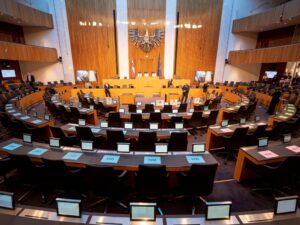
Austria Votes—Will the Cordon Sanitaire Hold?
AUTHLIB Panel Discussion
UPCOMING EVENT!
Tuesday, October 1, 2024
4:00 p.m. – 5:30 p.m. CET
Austria is approaching a pivotal moment as it holds on September 29 possibly its most consequential federal elections in decades—for the country and for European politics. The radical-right Freedom Party of Austria (FPÖ), twice a junior partner in coalition governments in the past two decades, is leading in the polls and aiming for the chancellor’s office.
What social, economic, and political shifts have led to this troubling scenario for Austria and Europe? Will the conservative Austrian People’s Party (ÖVP) agree to be the crucial coalition partner for the FPÖ, or will it opt instead for a centrist-progressive alliance even if this may cost it politically in the long run?
Illiberal Challengers of Liberal Democracy in Europe
AUTHLIB Panel Discussion

Illiberal and populist forces have become a stable feature of European politics. By undermining democratic norms, promoting illiberal policies, and threatening the rule of law, these actors pose a critical challenge to liberal democracy when they hold executive office. Their rise also often correlates with increased polarization and the erosion of trust in democratic institutions.
The discussion explored the varieties of illiberalism in Europe, the reasons behind the appeal of such forces, and their potential impact on policies as well as the integrity of democratic institutions and norms. It took a closer look at the dynamics that are at play behind the rise of different kinds of illiberals in Austria and the Czech Republic.
The panel took place at the Budapest Forum on September 18, and was organized in cooperation with the CEU Democracy Institute, the City of Budapest, and Political Capital.
AUTHLIB at the 30th CES International Conference of Europeanists
AUTHLIB Conference Participation

The AUTHLIB team participated with three panels at the 30th International Conference of Europeanists in Lyon, France, where our researchers had the opportunity to discuss their research on various challenges to liberal democracy in Europe. The conference also provided an opportunity for a consortium meeting to discuss the progress made in AUTHLIB’s work packages in person and review our plans for the coming months.
Our panels discussed the transnational diffusion of illiberal politics, autocratic attitudes and discourse, and illiberal challenges in Central and Eastern Europe.
Publications
After a short summer break, the AUTHLIB Blog restarted in August to disseminate fresh insights into the consortium’s research findings to academic and policy communities.
The AUTHLIB Blog is a platform of academic and policy debate publishing commentary, analysis, and opinion pieces around the topics of (neo-)authoritarianism, illiberalism, populism, challenges to liberal democracy, democratic erosion and backsliding, democratic security and resilience, and related political events and developments primarily but not exclusively on the European scene. It seeks to facilitate discussion between the scholarly and policy communities dealing with the above questions, in a language that is accessible also to the broader public.
Over the past months, articles published on the AUTHLIB Blog covered the polarization underlying the presidential election in Slovakia; how populism and EU-skepticism shape party support for Ukraine; what impact the European Parliament elections has on the EU’s democracy and rule of law agenda; the creeping influence of the radical right in the EU and the emergence of a new cleavage around the center’s cooperation with it; and the role of state-funded disinformation campaigns in Hungary’s elections.
The AUTHLIB Blog welcomes submissions from the academic and policy community. Should you be interested in contributing, contact Zsuzsanna Végh, visiting fellow at the German Marshall Fund of the United States, with your short pitch at: zvegh@gmfus.org
During 2024, several articles written by AUTHLIB researchers were published in academic journals. Below is a selection of those whose publication was facilitated by the project.
AUTHLIB Journal Articles
Illiberal conservatism, civilisationalist ethnocentrism, and paternalist populism in Orbán’s Hungary
Building on his AUTHLIB Working Paper, AUTHLIB consortium lead Zsolt Enyedi (Professor, Central European University; Senior Researcher, CEU Democracy Institute) published his article titled “Illiberal conservatism, civilisationalist ethnocentrism, and paternalist populism in Orbán’s Hungary” in Contemporary Politics.
ABSTRACT
The paper argues for an ideology-centred interpretation of the Orbán regime. Those regimes are considered ideology-centred that promote a particular worldview through discourse, consequential policies and the allocation of resources. In addition to demonstrating that Hungary after 2010 satisfies these criteria, the paper identifies three principal ideological modules of the regime: illiberal conservatism, civilisationist ethnocentrism, and paternalist populism.
Access the full article HERE.
Positive Authoritarianism in Poland and Hungary
Franziska Wagner (PhD Candidate, Central European University) and Zsolt Enyedi (Professor, Central European University; Senior Researcher, CEU Democracy Institute) published their article titled “They can do it. Positive Authoritarianism in Poland and Hungary” in Frontiers in Political Science. The article is based on research conducted in the framework of AUTHLIB.
ABSTRACT
It is often assumed that right-wing authoritarian and populist parties appeal primarily to negative feelings such as frustration, fear or alienation, and that positive sentiments appear in their discourse mostly in the form of nostalgia. Our hypothesis is that this description fails to apply to leaders in power. This article employs a mixed-methods approach, using a novel dataset of Viktor Orbán’s (Fidesz – Hungary) and Jarosław Kaczyński’s (PiS – Poland) speeches. After grouping positive sentences, a structural topic model identifies central topics, while the qualitative part describes and contextualizes the nature of the detected positive messages. Our analysis reveals that Orbán and Kaczyński incorporate various types of positive sentiments, such as optimism, pride, and efficacy, into their discourse. Contrary to popular belief, they dedicate considerable attention to discussing the future and utilize various rhetorical devices to convey positive messages. These messages are intrinsically interwoven with the leaders’ visions of past and future, offering insights into the underlying framework of their fundamentally conflict-centered and illiberal worldview. This study challenges the notion that right-wing authoritarian politics rely solely on “politics of fear”. Instead, it suggests that such leaders employ positive affective appeals as a form of emotional governance.
Access the full article HERE.
Concept and Varieties of Illiberalism
Zsolt Enyedi (Professor, Central European University; Senior Researcher, CEU Democracy Institute) published an article titled “Concept and Varieties of Illiberalism” in Politics and Governance. The article is based on research conducted in the framework of AUTHLIB.
ABSTRACT
This article discusses various conceptualizations of illiberalism and adopts a definition that equates the concept with the negation of three liberal democratic principles: limited power, a neutral state, and an open society. The second part of the article explores the implications of this definitional strategy for empirical research, describes the relationship between populism, authoritarianism, and illiberalism, and identifies nine distinct routes to illiberalism: authoritarian, traditionalist, religious, libertarian, nativist-nationalist, populist, paternalist, materialist-technocratic, and left-wing.
Access the full article HERE.
AUTHLIB Blog
How the EU’s Response to Democratic Backsliding Has Affected Support for Europe

The EU’s inadequate response to democratic backsliding has created frustration among some former Europhiles in Poland. This has given rise to a new group of people – the “Eurodisappointed” – who dampen their enthusiasm for European integration, argue Radosław Markowski and Piotr Zagórski (both SWPS University).
Projecting a Brighter Future: Positive Authoritarianism in Hungary and Poland
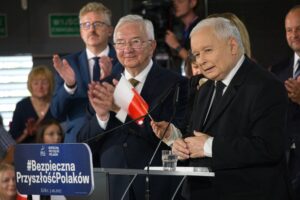
Authoritarian, illiberal and populist actors are perceived to evoke negative sentiments and to prefer talking about the past rather than the future. In a recently published quantitative and qualitative analysis of speeches of two such leaders, Viktor Orbán and Jarosław Kaczyński, Franziska Wagner and Zsolt Enyedi (both CEU) suggest that this is not necessarily so. Their attacks against liberalism and against the West are couched in an upbeat, future-looking discourse, and their deeply ideological arguments are combined with a stress on competence.
Risen from the Ruins or Irreparably Divided? Radical-Left Protests in Saxony
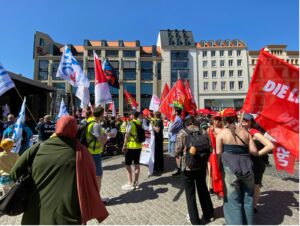
Amid rising political violence and the growing threat from the radical right in the lead-up to the state elections in Saxony, Germany, various radical-left actors have also taken to the streets to mobilize support for their political objectives. These actors engage with foreign policy issues strategically and criticizes Germany’s government. In addition, the radical-left scene has become more dynamic with the emergence of the new Sahra Wagenknecht Alliance party. A look from the field by Aleš Michal (Charles University).
Extreme Sovereigntism and Its Relation to Contemporary Liberal Democracy: The Case of Czechia

Extreme sovereigntist movements pose a significant threat to democracies worldwide. They employ strategies that challenge the legitimacy of the state and often do not hesitate to use political violence to achieve their goals. In Czechia, the movement has two branches, differentiated by their relationship to historical developments and the interests of key figures within them. Aleš Michal (Charles University) explores this lesser studied movement.
Defecting From a Dominant Party: A Backlash Against Personalization

Dozens of former party elites of the ruling AKP in Turkey left and joined two break-off parties in 2019 and 2020. Their move to the opposition was driven by self-interest rather than a principled commitment to democratic values, argues Dean Schafer (CEU). Analysis of statements on social media before they left show they were concerned about the personalization of political power and not the repression of journalists or minorities.
The project “AUTHLIB – Neo-Authoritarianisms in Europe and the Liberal Democratic Response” is funded by the European Union and the UK Research and Innovation. Views and opinions expressed are however those of the author(s) only and do not necessarily reflect those of the European Union or UK Research and Innovation. Neither the European Union nor the UK Research and Innovation can be held responsible for them.


